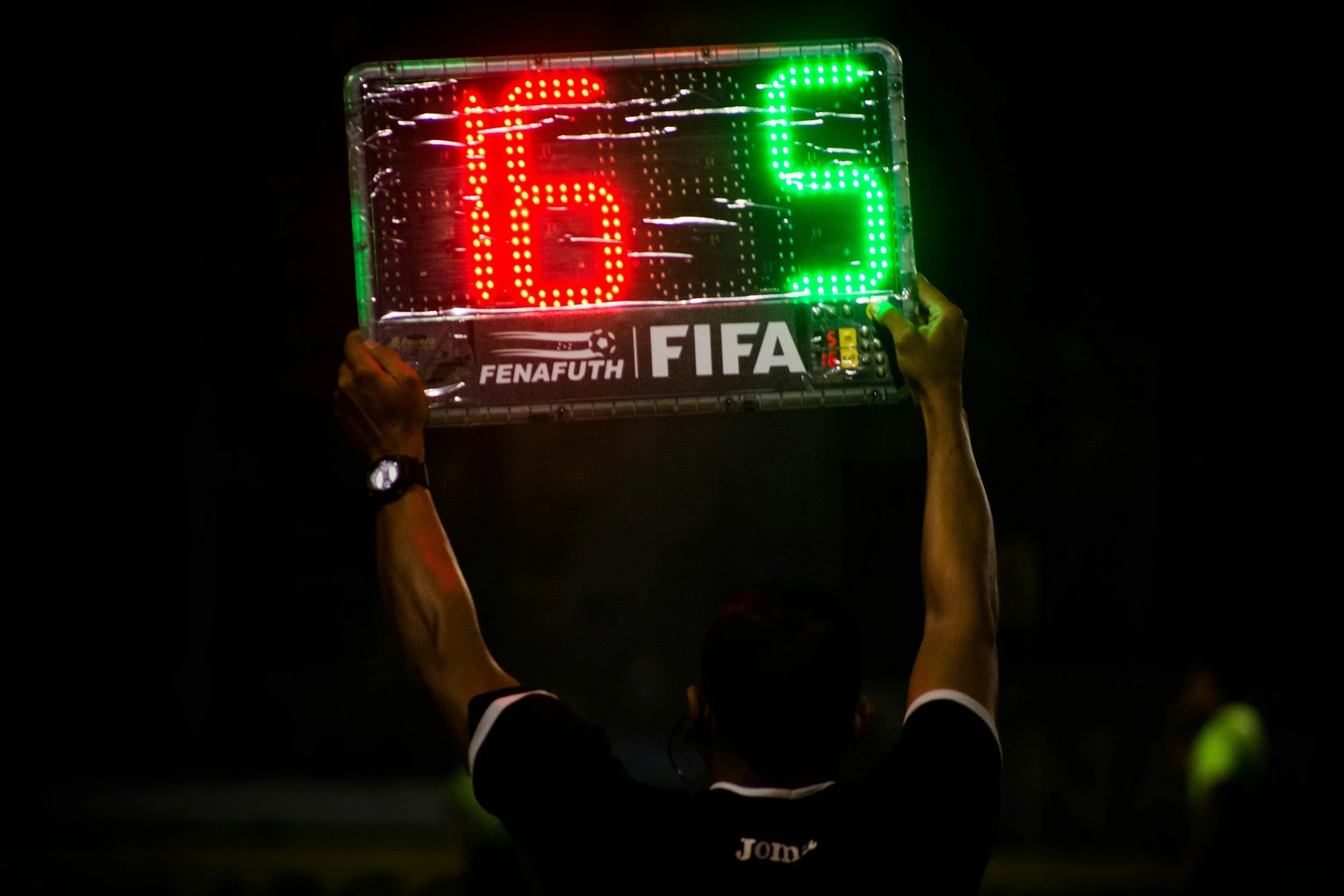
Orlando Sierra for Agence France-Presse (AFP) via Getty Images.
‘Consistency. That’s all we’re asking for!’
Simple right? If officials were just consistent, then all other deficiencies could be forgiven, once they are consistently applied. Unchanging in nature, standard and accuracy.
The supposition is; if officials were to fulfill this elementary request of many sports pundits, coaches and fans, consistency would broadly satisfy all involved.
While it’s quite a reasonable sounding demand, as officials, we know the practicality of attaining it is infinitely more complex.
In team sports at all levels, most publicly, the pro level, consistency is often cited as the most valued and desired quality of sports officials; yet its very definition and intent within the context of officiating remains elusive.
It’s a complicated term to define, let alone measure and apply. So why is it thrown around so much as a sober and reasonable request by critics, and proposed as an aspirational state, by officiating bodies? Is consistency ultimately achievable? Or an insidious paradoxical demand?
Foul Logic
Let’s first question consistency’s connection to its natural counterpart: accuracy. Considering the accuracy statistics from many major professional leagues in Europe and North America over the last several years, one thing is clear; pro officials in team sports are highly accurate. In NFL, MLB, NBA, EPL, UEFA and FIFA studies, officiating accuracy of rule application is in the 85-90%+ bracket for all national leagues and international competitions. Call inaccuracy becomes a negligible percentage once video review is utilized. [1, 2, 3]
Under this parallel, accuracy does not appear to be the missing link connecting officiating satisfaction that balances precision or exactness with broadly fair application, and ultimately, consistent officiating.
Given this delta, it becomes more difficult to connect consistency with a simple request for accurate rule application; applied in collaboration with proficient mechanics, nuanced judgement, adequate positioning, clear communication and sensible game management skills.
A significant volume, or at least, the most repeated public demands for consistency are initiated by pro-sports commentators. Naturally, at the pro level, there are more resources allocated to scrutinizing the performances of officials by networks and sports press. Most recently, in 2025, there has been a very public and energized focus on the inconsistent performance of WNBA referees. [4]
While there is no verified data on this specific league’s 2025 season available at the time of writing, it’s worthwhile to note that officiating parties are in agreement; with the WNBA commissioner conceding that ”...consistency is the name of the game.” in reaction to the significant negative press and complaints surrounding its officiating. [5]
Critics are demanding consistency. Official’s bodies generally agree, noting consistency as an aspirational goal and a practical project. This peculiar situation is not uncommon, it’s just the most recent example. Let’s be honest- who would blame them for settling on this word to agree on? If there is a term that could remove tension, assure observers that all sides see the issue and are steadfast in rectifying it while pointing to a consensus that improvement is needed while validating all viewpoints- why not use it?!
The contemporary demand for consistency has effectively behaved as an effortless and powerful placeholder, it presents as a reasonable correction that provides common ground for reflection and development. It satisfies a broad range of frustrations without sounding unreasonable or biased.
Additionally, the request for consistency is usually flanked by perceptions of inaccuracy and bias on behalf of the official. However, as officials we experience it differently; this insistence on consistency is not only partisan, but misguided and inoperable.
Given the data and the complexity of the demand, let’s open up this idea that consistency should be a goal or an aspirational state for sports officials. [6]
The Consistency Myth
Article originally published in Referee Magazine by National Association of Sports Officials (NASO) October 2026.
Contrary to Life
We often hear that a call in the first minute should be a call in the last minute. A very easy thing to say, but the reality and implications would give most officials massive pause at that last minute. Rigid consistency, if possible to establish, could arguably become a liability to both to the quality of officiating and the natural enjoyment and flow of competition. [7] There have been some excellent studies conducted over the last several where it is clear that even in one or two hyper-specific areas/calls in sports officiating, the presence or possibility of consistency is inconclusive at best. [8]
English writer and philosopher, Aldous Huxley, once wrote: ‘Consistency is contrary to nature, contrary to life. The only completely consistent people are the dead.’ [9] Humans, even officials, are inherently inconsistent due to emotion, stress, fatigue and circumstance.
Subjectivity is another contributor to the difficulty of defining and implementing this demand. [10] There have been many wonderful articles published in this magazine on the concept of ‘consistency for me, but not for thee’. [11] Subjectivity in measurement of fairness or accuracy means that consistency would have to shapeshift often to meet the momentary expectations of the coach, athlete or pundit.
Ultimately, the demand for consistency always returns to this oversimplification of a very technically complex and very human inadequacy. It’s both insidious and paradoxical. It’s insidious because the deceptive nature of the demand changes and is not immediately obvious. It’s paradoxical because it puts the official in a no-win situation.
We could go on discussing this paradox and bashing the concept against the realities of human fallibility and situational differences that won’t all neatly fit together in thousands of different settings. But it may be more ambitious and helpful to address the underlying issue; there is a practical need for a more nuanced and definite framework to discuss officiating performance and expectations.
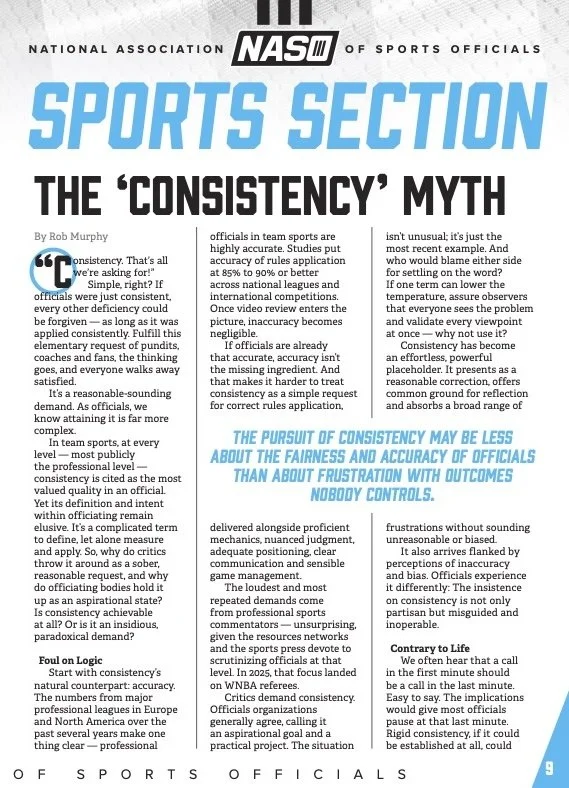
The Consistency Myth
Article originally published in Referee Magazine by National Association of Sports Officials (NASO) October 2026.
Goalposts
Growth and quality regularly emerge when consistent patterns are broken or replaced by new ones. If consistency is extremely difficult to qualify- perhaps we should stop chasing it as it’s equally unlikely to be the solution to its own problem. It could be more promising to look to new frameworks for discussing officiating performance.
Is there an off-the-shelf solution available that is easily implemented, easy to understand and agree on? Not likely. However, that slide into simplification is what threw us into this orbit initially. Alternatives will, admittedly, carry their own issues.
There would be some uncomfortable adjustments for many. It would require our official’s orgs to stop enabling calls for consistency without a coherent resolution plan and start promoting alternative narratives that publish, promote and actively engage in frameworks that are reasonable and vastly more verifiable.
There are some wonderful examples of thoughtful approaches, like the ‘Game Management Framework for Sports Refereeing’ (GMFSR) [12] that speak both to the need for clear grading against the desired qualities of officials that include tangible and interrelated demands on the art and science of officiating a game.
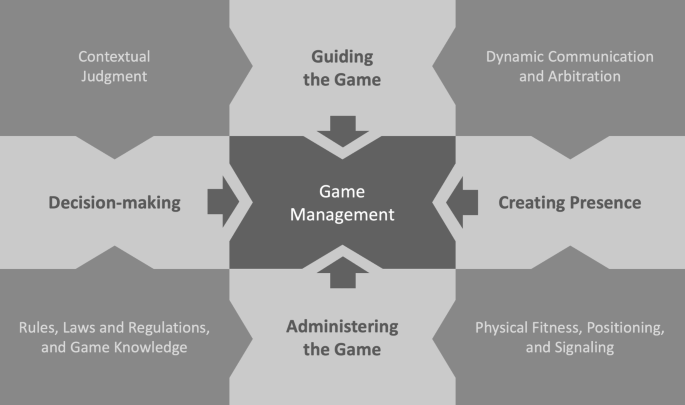
FIg 1. The Game Management Framework for Sports Refereeing (GMFSR). Game Management (center) is a competency defined as the integration of the concepts and skills necessary to manage the demands of officiating a game. Four Skills (light gray) are derived from the four essential concepts and are necessary for the effective application of officiating knowledge and judgment in games. Four Essential Concepts (dark gray) are rooted in knowledge and performance and are integral to a referee's proficiency, competence and effectiveness.
While this is only one example of an alternative, it offers a more realistic approach that can speak to most forms of officiating. While it’s certainly not as easy to induce as a loaded and agreeable word like ‘consistency’ in criticism of an official's performance, at least it’s rooted in reality. If we are to escape the repetitive and unaccountable dialogue surrounding consistency, we need this, or something like it, to improve both our performance and the quality of discussion around it. While perfect consistency will struggle to prevail given its complexity and human folly- there may be a way functional consistency could be created, within a framework like the GMSR.
As it currently stands, the pursuit of consistency may be less about the fairness and accuracy of officials, and more about frustration with the lack of control over unpredictable outcomes. This frustration seems to be enhanced by our inability to rest on a common understanding of it.
Until we can replace the conversation around consistency with an alternative, or define it more eloquently and technically, demanding it may say more about exterior expectations than the official's performance itself.
R. Murphy
*Cover image credit: Orlando Sierra for Agence France-Presse (AFP) via Getty Images.
F. Yeqin Zhang Et al. Psychol., The effect of the video assistant referee (VAR) on referees' decisions at FIFA Women's World Cups 11 August 2022, Sec. Movement Science, Volume 13 - 2022.
Gavin McDermott, Matthew Hettleman, Leah Kozel, Virginia York. McDermott – Every Second Counts: Using Big Data to Investigate Referee Accuracy in NBA Games | Office for Undergraduate Research
L2M NBA Statistics , Hoopshype.com, 2024. NFL Accuracy, NFL.com, 2023. MLB Umpire Accuracy. Sportslawblogger.com, 2023.
Holleran, Andrew, and Emilee Chinn. “WNBA Announces Decision On League's Officiating Problem.” The Spun, 20 July 2025.
Graham, Bryan Armen. “No one comes to watch the referees. But in the WNBA, they're the story | Bryan Armen Graham.” The Guardian, 1 October 2025.
David Butler, Robert Butler, Carl Singleton, Journal of Sports Economics, 2025, ISSN: 2365-9793, IZA DP No. 17718: Objective Calls Under the Spotlight: Referee Consistency and Behaviour on Football's Biggest Stage
Ben Yeoh Chats, Jan 12th 2025, Podcast, Spotify, Football, VAR Video Assisted Referee, Education, and the Art of Learning
David Butler, Robert Butler, Carl Singleton, Journal of Sports Economics, 2025, ISSN: 2365-9793, IZA DP No. 17718: Objective Calls Under the Spotlight: Referee Consistency and Behaviour on Football's Biggest Stage
Aldous Huxley, Do What You Will, ‘Wordsworth in the Tropics’. 1929.
Ben Yeoh Chats, Jan 12th 2025, Podcast, Spotify, Football, VAR Video Assisted Referee, Education, and the Art of Learning
Referee Magazine. ‘Insistence on Consistency’, September, 2021.
Theresa Hoffmann, Clare MacMahon and Ralf Brand, ‘Game Management Framework for Sports Refereeing…’ August 2024.
